
Portraits of the Invisible Within Us
By Maria Toneva for "Woman Today" magazine
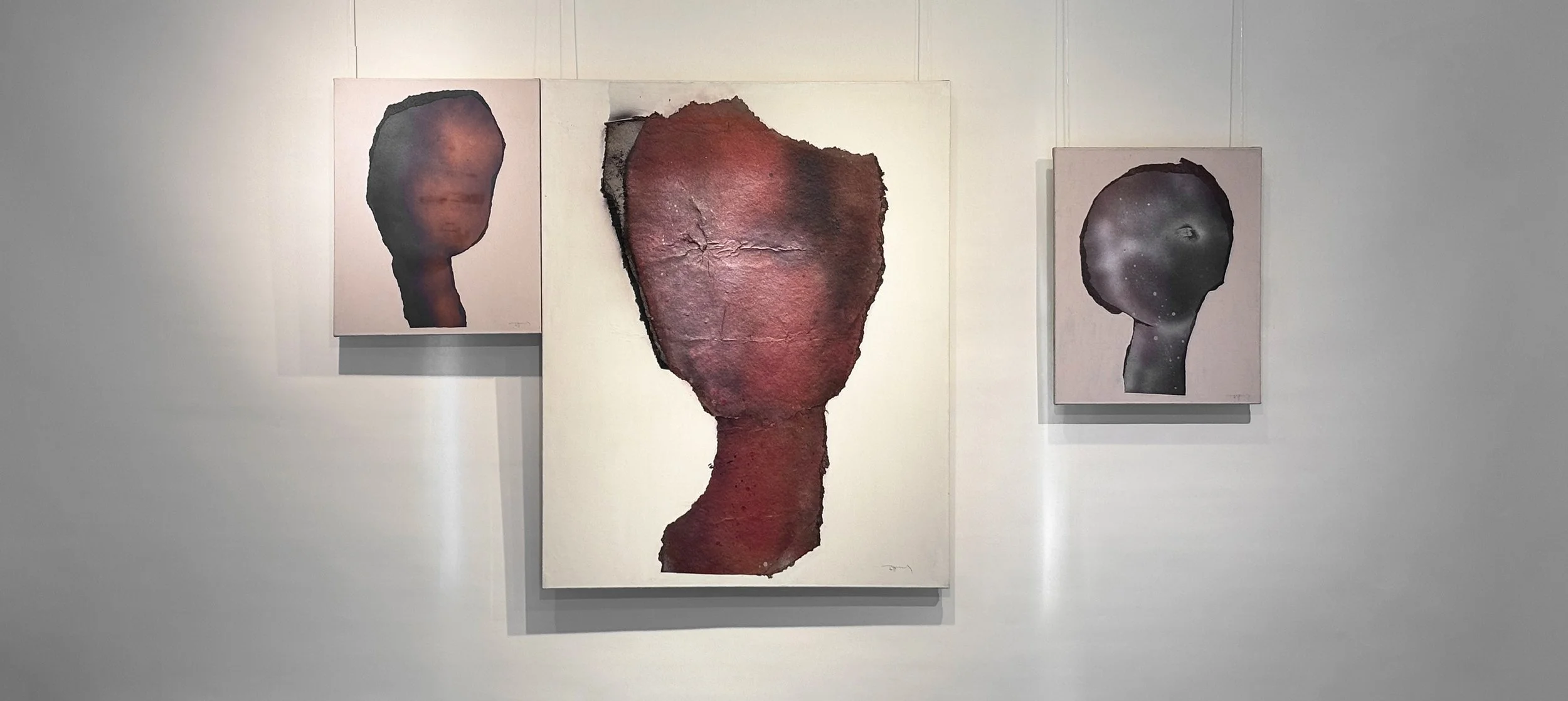
Talent and success are not always a guaranteed partnership, but when an artist has the courage to look within, that gaze inevitably finds its way to others as well. At the beginning of March, in the intimate setting of Sofia's Serdika Gallery, Boriana Mihailovska presented not merely an exhibition, but a deeply personal story about identity. Identities does not seek outward resemblance, but rather an inner truth—often invisible, yet profoundly recognizable. In a world saturated with images, the artist chooses to return to the quietest thing of all - the inner voice. Her portraits do not insist, explain, or impose. They simply exist. And in that presence lies something rare and valuable—the permission to be ourselves.
We spoke with Boriana about the courage to take risks in art, her creative collaboration with musical virtuoso John Legend, and the small steps that lead to major recognition in the global artistic community.
How did abstract heads become your artistic language, and do modern people live more inside their own heads?
In my exhibition Identities, I presented works inspired by a powerful inner need to feel valuable and significant again. This series of portraits was born during a period when I was completely devoted to caring for my children and family. Women often identify themselves through their families, which is understandable, but I felt a need to rediscover myself beyond the roles of mother and wife—to steal a little time for the things that interested me beyond everyday life. I believe this actually adds value to life because when you know who you are, you become a more complete person for those you love as well. I have the feeling that today people live more for external approval. My aim was to turn the gaze inward—to allow ourselves to like who we are, even unfinished, and to realize that despite all our imperfections, we are worthy human beings.
You've said that you never intended to show these works publicly. How did you discover that they resonated with other people's emotional worlds?
These abstract portraits were very personal, and at first I saw their meaning primarily for myself. But gradually people began to identify with them—they often saw themselves or someone close to them in the images. The works turned out to be like a friend, offering inner confidence, calm, and strength. That was a great surprise to me and helped me understand how much people need support. I realized how profound the absence of this kind of "conversation" is—a quiet, unobtrusive, yet deeply human one.
What is the essence of collage, and what characterizes your personal approach to it?
I like tearing paper and not having complete control over it or over the final image. The process feels very natural because it reminds me of life itself—you have an intention, you make an effort, but you never fully control the situation. You have to recognize the image that begins to emerge and develop it. The imperfections that arise during the process, in my opinion, make the final image more truthful and alive, much like us as human beings. The backgrounds in the Identities series are white, almost untouched, leaving the figures in an undefined environment. Perhaps that's why people find it easier to identify with them—there are no interpretive directions. To a large extent, viewers are free to create their own meanings, and most of those interpretations become deeply personal recognitions.
Is it difficult to reconcile authenticity and commercial success in contemporary art? How does aesthetics become both artistic and market value?
It turns out that even when art is highly commercial, the intention behind it is something people can sense, even if it is invisible and impossible to explain. There's often no need for extensive explanations because audiences recognize sincerity. Authenticity has its own distinct character; it cannot be imitated. I believe it comes from the layers of experience artists carry within themselves and from the things that move them both as people and as creators. Art is an absolute mirror—you cannot deceive through it.
In 2013, you began offering your prints through Etsy. How did that idea emerge, and how has the digital marketplace changed the way art reaches people?
The paper itself attracted me—it was the catalyst. It happened while I was working as art director on the television series The Unforgiven, where we needed to recreate an aged photograph for the final episode. We tested various textured papers to achieve maximum authenticity. That's when I discovered a special paper designed for fine art reproductions and artistic photography. I had already digitized several of my black "heads" and was tempted to see them printed on it. I loved the result. That's how my first art prints were born, along with the idea of offering them online. The audience that comes through Etsy is very different from the audience that would visit a traditional gallery. Some people are art enthusiasts and collectors, but many are part of a broader public. Clients have told me that they had never had the courage to enter a gallery before, but after buying one of my works online, they became more interested in art. For me, that's the greatest possible compliment—to open a door and spark curiosity about something new. A print is, of course, a much more accessible way to own art and ideal for beginning collectors. Very often, it inspires a desire to own the original work. When I started selling my works as prints, I felt that even as reproductions they carried a sense of the original's uniqueness, which is why I insist on signing every art print.
Your collaboration with music star John Legend is a remarkable recognition of your talent. How did you connect, and what did you create together?
After reaching a large audience through Etsy, I received an invitation from the platform itself. It arrived completely unexpectedly on the last working day before Christmas in 2022. The email described an upcoming collaboration with a very famous artist and asked whether I would be interested in participating. I would only learn the artist's name if I accepted. I thought, "Why not?" By December 27, I knew that the project involved creating a collaborative artwork with John Legend as part of his Etsy partnership. It was a limited-edition home collection featuring ten other artists from around the world. The collection was inspired by the atmosphere and style of his new home. I was asked to submit several proposals. I created three options, digitized them, and followed very specific requirements regarding materials, textures, and colors. Everything happened very naturally and smoothly.
What is the most valuable lesson you learned from Svetlin Rusev?
One of the things Svetlin Rusev taught us was to work for the sake of art itself and not to seek the audience's approval, despite how much today's world revolves around it. In a way, he prepared us for the difficulties we would face. On a personal level, when I first created my large abstract-head collages and exhibited them in a group show, he congratulated and encouraged me. At that moment, I realized that although the direction I was taking was unfamiliar, it was not the wrong one, and I continued forward. I belonged to his last generation of students. He was incredibly supportive and generous with us, giving his time and energy to pass on everything he valued in art. And I've always felt extremely lucky to be a part of it.
The original text from the magazine "Woman Today"